
Getting a Broker Bond in Columbus, Ohio: The Freight Broker’s Complete Guide to BMC-84 Bonds
If you are launching or growing a freight brokerage in Columbus, Ohio, one requirement will show up before you ever book your first load: the broker bond. Every licensed freight broker operating in the United States is required by the Federal Motor Carrier Safety Administration to carry this bond, and Columbus brokers are no exception. Whether you are setting up shop near the Rickenbacker Inland Port, working out of a downtown office on 3rd Street, or running a lean operation from home in Dublin, Westerville, or Grove City, you cannot legally operate without one. In this guide, we break down exactly what this bonding requirement is, why Columbus-based freight brokers need one, how much it costs, how the application process works, and how our local agency helps trucking and logistics professionals across Central Ohio get a broker bond quickly and affordably.
What Is a Broker Bond?
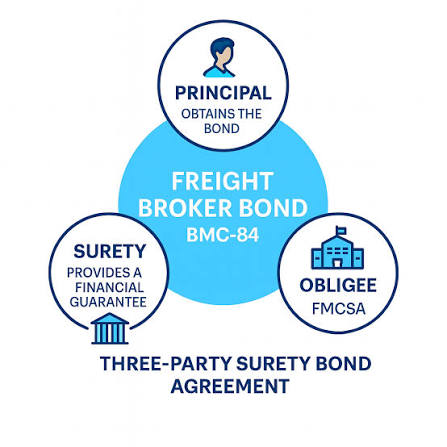
A broker bond, formally known as a BMC-84 surety bond, is a three-party financial guarantee required by the FMCSA for anyone operating as a licensed freight broker. The three parties are the broker, the surety company that issues the instrument, and the FMCSA, which acts on behalf of shippers and motor carriers who do business with your brokerage. In plain terms, this bond is a promise. It tells the freight industry that if your brokerage fails to pay a motor carrier or shipper what is owed, there is a financial backstop in place to make that carrier or shipper whole, up to the bonded amount.
Unlike an insurance policy, a broker bond does not protect you, the broker. Instead, it protects the people you do business with. If a claim is filed and validated, the surety company that issued the bond will pay out the claim, and then your brokerage is responsible for reimbursing the surety for that amount. This is a critical distinction that many new freight brokers in Columbus do not fully understand until they are already deep into the licensing process, so it is worth repeating: this bonding requirement exists to protect carriers and shippers, not to shield your company from lawsuits or losses.
Why Every Columbus Freight Broker Needs a Broker Bond
Freight brokerage is a booming industry in Columbus, thanks in large part to the city’s central location along major interstates like I-70 and I-71, as well as the presence of the Rickenbacker Inland Port, one of the busiest inland logistics hubs in the country. With so much freight moving through Central Ohio every day, brokers in this market handle enormous volumes of freight, and the FMCSA wants to make sure carriers get paid on time.
Federal law requires any company or individual that arranges the transportation of freight for compensation, without physically transporting it themselves, to obtain a freight broker license and post a bond. The current minimum amount required by the FMCSA is $75,000. This requirement was raised from $10,000 back in 2013 specifically to give carriers and shippers stronger financial protection, and it has remained the standard ever since. Without an active broker bond on file, the FMCSA will not issue or maintain your broker authority, which means you legally cannot operate as a freight broker in Ohio or anywhere else in the country.
For Columbus brokers working with carriers hauling loads to and from the Rickenbacker Inland Port, Norfolk Southern’s intermodal terminal, or the dozens of distribution centers scattered throughout Franklin County, having active bonding coverage is not optional. It is the price of admission to operate legally in this industry, and it signals to the carriers you work with that your brokerage takes its financial obligations seriously.
How Much Does a Broker Bond Cost in Columbus, Ohio?
The good news for Columbus freight brokers is that this bond is far more affordable than most people expect. Because the required amount is set at $75,000 by the FMCSA, many assume the cost will be extremely high. In reality, you are not paying the full $75,000 out of pocket. You are paying a small annual premium, a percentage of that total obligation, based on your personal and business creditworthiness.
For freight brokers with strong personal credit, a broker bond premium in Columbus generally runs between 1 percent and 3 percent of the total bond amount annually, which works out to roughly $750 to $2,250 per year. Brokers with average credit may see premiums land between 3 percent and 6 percent, while brokers with weaker credit histories could pay anywhere from 6 percent to 15 percent or more. Surety companies calculate these premiums using a risk-based formula that weighs your credit score, time in business, financial statements, and industry experience.
New freight brokers in Columbus who are just starting out, and who may not yet have an established business credit profile, should expect to pay toward the higher end of that range for their first bond. As your brokerage builds a track record and your credit strengthens, your renewal premium typically decreases, sometimes significantly, at the next renewal cycle.
| Credit Profile | Typical Annual Premium | Estimated Cost on $75,000 Bond |
|---|---|---|
| Excellent credit | 1% – 3% | $750 – $2,250 |
| Average credit | 3% – 6% | $2,250 – $4,500 |
| Challenged credit | 6% – 15%+ | $4,500 – $11,250+ |
The Application Process for a Broker Bond
Getting bonded does not have to be complicated, especially when you work with an agency that understands the freight industry and the Ohio market. Here is what the process generally looks like for Columbus-area freight brokers.
Step one: Determine your bond requirement. As mentioned, the FMCSA requires a $75,000 broker bond for standard freight broker authority. This amount applies whether you are a solo operator working from a home office in Hilliard or a growing brokerage with a team downtown.
Step two: Complete an application. Surety providers will ask for basic information about your business, including your legal business name, your FMCSA docket number if you have already applied for authority, and information about the principals of the company.
Step three: Underwriting and credit review. The surety company reviews your personal credit, and sometimes business financials, to determine your premium rate. This step is where working with an experienced agency pays off, since we know which surety markets are most competitive for brokers with different credit profiles.
Step four: Bond issuance. Once approved, your bond is issued and filed electronically with the FMCSA through the BMC-84 form. This typically happens quickly, often within one to two business days once underwriting is complete.
Step five: Maintain your bond. Coverage must remain active for as long as you hold broker authority. If it lapses or is cancelled, the FMCSA can suspend or revoke your operating authority, so timely renewal is essential.
What Happens If You Operate Without a Broker Bond?
Operating as a freight broker in Columbus without one is not just risky, it is illegal. The FMCSA requires continuous coverage for every licensed broker, and if your bond is cancelled or expires without a replacement in place, your broker authority will be revoked. This means you would have to stop brokering loads immediately and reapply for authority from scratch, a process that can take weeks and disrupt relationships with the carriers and shippers you have worked hard to build.
Additionally, if a claim is filed against your broker bond and it is found valid, you are personally and financially responsible for reimbursing the surety company for whatever was paid out. Multiple claims or a pattern of nonpayment can also make it significantly harder, and more expensive, to secure coverage in the future, since surety companies view repeat claims as a major red flag during underwriting.
Broker Bonds vs. Broker Trust Funds
Some freight brokers ask whether they can use a trust fund instead of a broker bond to satisfy the FMCSA requirement. The answer is yes, technically, but in practice almost every Columbus freight broker chooses the surety bond option. A trust fund requires you to set aside the full $75,000 in a dedicated account, money that is then tied up and unavailable for use in your business operations. A surety bond, by contrast, only requires a small annual premium payment, leaving your working capital free to grow your brokerage, hire staff, and invest in load boards, technology, and marketing. For nearly all Columbus-based freight brokers, the bonding route is the far more practical and cash-flow-friendly choice.
The Rickenbacker Effect: Why Columbus Brokers Face Unique Bonding Pressure
Columbus is not a typical mid-sized market when it comes to freight. The Rickenbacker Inland Port moves an enormous volume of air, rail, and truck freight every year, and it has turned Central Ohio into one of the fastest-growing logistics corridors in the Midwest. That growth has attracted a wave of new freight brokerages headquartered right here in Columbus, all of which need a broker bond before they can legally book their first load out of Rickenbacker, the CSX intermodal terminal, or any of the region’s sprawling distribution parks along Alum Creek Drive and Groveport Road.
This growth also means competition among Columbus brokers is fierce, and carriers have options. A broker who can demonstrate strong financial backing, including a properly maintained bond, has an easier time convincing quality carriers to haul their freight. In a market as active as Columbus, your bonding status is part of your reputation.
Why Local Expertise Matters When Getting a Broker Bond
Freight brokerage is a relationship-driven business, and Columbus has its own unique logistics landscape. From the intermodal activity at Rickenbacker to the warehousing corridor along I-270, local brokers deal with specific carrier networks, seasonal freight patterns, and regional shipper relationships that a national call center simply will not understand. When you work with a Columbus-based insurance and bonding agency, you get guidance from people who know the Ohio freight market and can match you with surety providers that offer competitive rates for brokers in this exact region.
Our team helps freight brokers throughout Columbus, Dublin, Westerville, Grove City, Reynoldsburg, Hilliard, and the surrounding Central Ohio area secure their bond quickly, often within a day or two of a completed application. We shop your application across multiple surety markets rather than locking you into a single provider, which means Columbus brokers we work with typically get a more competitive premium than they would going directly to one surety company.
Broker Bond Renewal and Ongoing Compliance
A broker bond is not a one-time purchase. It must be renewed annually to keep your broker authority active with the FMCSA. As your Columbus brokerage grows and your credit profile improves, your renewal premium often drops compared to your first-year rate. We recommend starting the renewal conversation with your agent at least thirty days before your expiration date to avoid any lapse in coverage, since even a short gap can trigger an FMCSA compliance flag.
It is also worth noting that if your brokerage changes its legal business structure, adds new principals, or experiences a significant shift in financial standing, the terms of your bond may need to be updated. Keeping your agency informed of these changes ensures your coverage stays properly matched to your current business.
Broker Bond Requirements Beyond the FMCSA Minimum
While $75,000 is the federal floor, some shippers and larger carriers in the Columbus market ask brokers to demonstrate additional financial strength before signing a contract. This does not usually mean a higher bond amount, since the FMCSA sets a single national requirement, but it can mean shippers request proof of your bond status, your years in business, and your claims history as part of their own vetting process. Keeping documentation of your active bond on hand, along with your MC number and certificate of authority, makes it easy to respond quickly when a shipper or carrier asks for verification.
The Full FMCSA Licensing Path for New Columbus Freight Brokers
Getting bonded is only one piece of becoming a licensed freight broker in Columbus. Before a surety company can issue your paperwork, most new brokerages need to work through several other FMCSA steps, and understanding the whole path helps you plan your timeline and budget more accurately.
First, you will register your business entity with the Ohio Secretary of State, choosing a structure such as an LLC or corporation that fits your liability and tax goals. Many new Columbus brokers work with an accountant or attorney during this step, since the entity you choose can affect how underwriters evaluate your surety application later on.
Second, you will apply for operating authority through the FMCSA’s Unified Registration System, which generates your MC number once approved. This is also when you designate a process agent, a company or individual authorized to accept legal documents on your behalf in every state where you plan to do business.
Third, once your authority application is submitted, you have a window of time to file your financial responsibility paperwork, which is where your surety instrument comes in. The FMCSA will not grant final operating authority until this filing is completed and matched to your docket number.
Fourth, you will need a BOC-3 filing to designate process agents nationwide, along with proof of any required insurance policies your brokerage carries in addition to the federal bonding obligation. Once all of these pieces are on file, the FMCSA publishes your authority and you are cleared to start arranging freight.
For Columbus brokers, working with a local agency that understands each of these steps, not just the surety piece, can shave real time off your launch timeline. Our team routinely helps new brokerages sequence these filings correctly so nothing holds up your authority grant.
Serving Freight Brokers Across Greater Columbus
Our agency works with freight brokerages of every size across the greater Columbus metro area. That includes established firms in the Arena District and Short North with dedicated compliance teams, as well as solo operators running lean businesses from home offices in New Albany, Pickerington, Gahanna, and Powell. Wherever your brokerage is based in Central Ohio, the federal requirements are identical, and so is our commitment to fast, straightforward service.
We also work closely with owner-operators and small carriers throughout the region who partner with local brokerages, giving us a broad view of how bonding, insurance, and compliance fit together across the entire Columbus freight ecosystem. That perspective helps us give brokers practical, real-world guidance rather than generic advice pulled from a national script, and it means every recommendation we make is grounded in how freight actually moves through Columbus, Franklin County, and the wider Central Ohio region.
Common Questions Columbus Freight Brokers Ask About Broker Bonds
Do I need a broker bond if I only broker loads occasionally? Yes. The FMCSA does not distinguish between full-time and occasional freight brokers. Any entity arranging transportation for compensation without operating the vehicles themselves needs both broker authority and an active bond.
Can I get bonded with bad credit? Yes, though the premium will be higher. Many surety companies specialize in bonding brokers with challenged credit, and our agency works with several markets that focus specifically on higher-risk bond placements.
How fast can I get a broker bond in Columbus? In many cases, it can be issued within 24 to 48 hours of submitting a complete application, assuming underwriting does not require additional documentation.
Is a broker bond the same as freight broker insurance? No. This bond satisfies the FMCSA’s financial responsibility requirement and protects carriers and shippers. General liability, errors and omissions, and other freight broker insurance policies protect your own business from lawsuits, claims, and operational risk. Most Columbus brokerages carry both.
What happens at renewal if I have had a claim? A prior claim does not automatically disqualify you, but it may affect your premium. We work with underwriters who evaluate the full picture of your brokerage rather than declining coverage over a single incident.
Does the bond amount ever change? The FMCSA periodically reviews the required amount, and it was last raised in 2013. Columbus brokers should keep an eye on FMCSA announcements, since any future change to the bonding requirement would apply nationwide.
Choosing the Right Partner for Your Broker Bond in Columbus
Not every agency understands freight brokerage the way a dedicated trucking and logistics insurance specialist does. When you are shopping for coverage, look for a partner that can explain the process clearly, shop multiple surety markets on your behalf, and support you through renewals year after year. A good agency will also help you understand how your broker bond interacts with your broader insurance program, so you are fully protected and fully compliant from day one.
Columbus Commercial Truck Insurance works with freight brokers throughout Columbus and Central Ohio to secure competitively priced broker bonds, often with same-day or next-day turnaround. We understand the FMCSA’s BMC-84 requirements inside and out, and we take the time to shop your application across our network of surety partners so you are not overpaying based on a single underwriter’s rate card. Whether you are applying for your very first broker authority or renewing a bond you have held for years, our team is ready to walk you through every step, in plain language, without the jargon.
Get Your Broker Bond Started Today
If you are ready to secure your broker bond and get your Columbus freight brokerage fully compliant with FMCSA requirements, our team is here to help. We serve freight brokers throughout Columbus, Ohio, and the surrounding Central Ohio region, including Dublin, Westerville, Grove City, Hilliard, and Reynoldsburg, and we pride ourselves on fast, transparent service from application to issuance.
Columbus Commercial Truck Insurance is located at 175 S 3rd St, Suite 1420, Columbus, OH 43215, and our team is available by phone at (614) 587-3031. Reach out today to get your broker bond quote, and let our local expertise help your freight brokerage stay compliant, protected, and ready to grow in the Columbus freight market. Our agents are happy to walk through your specific situation, answer questions about credit and premium ranges, and outline the exact documents needed so your application moves smoothly from the first phone call to a fully issued, FMCSA-ready filing.

Leave a Reply